
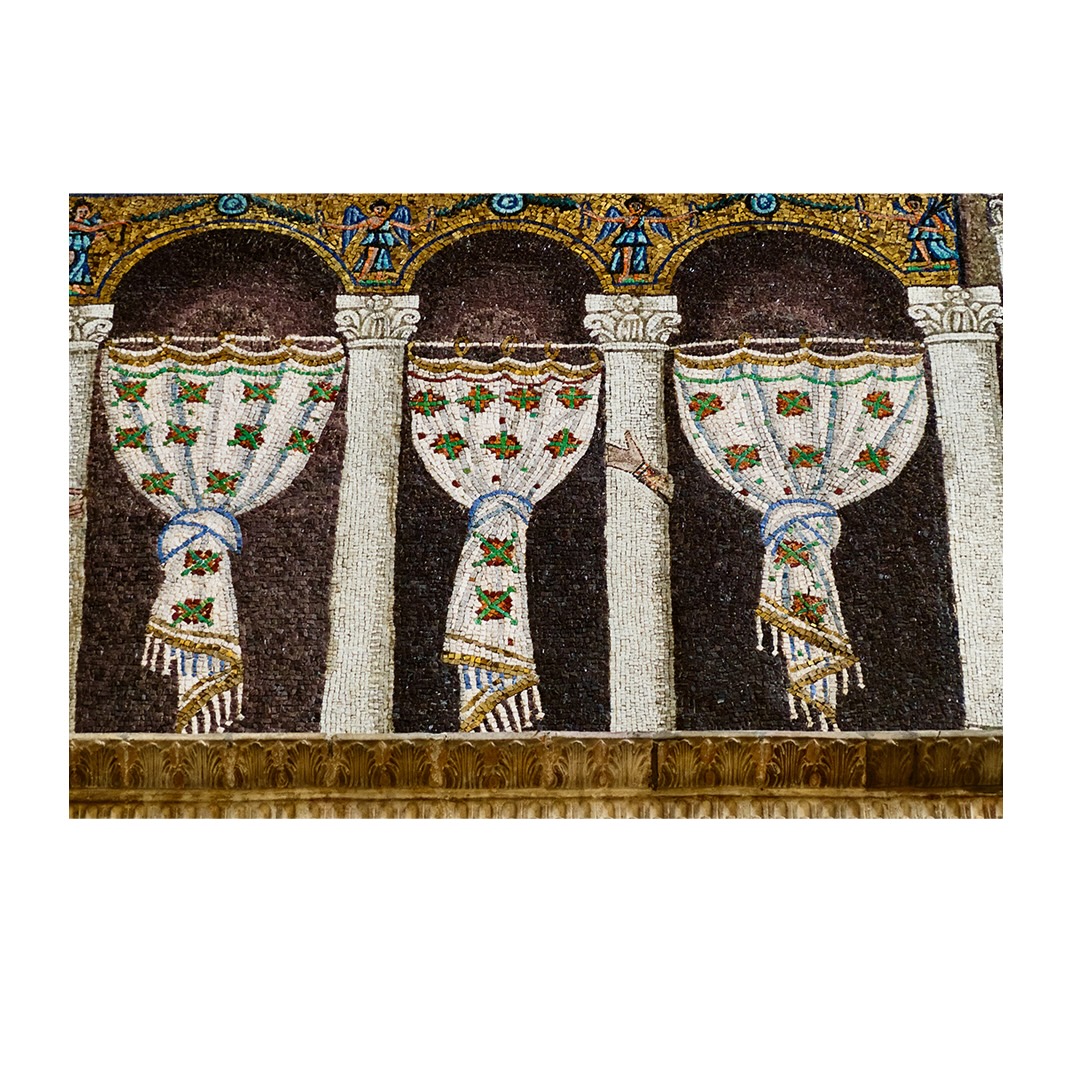
Memory of forgetting
°
We are in the Church of Sant’Apollinare Nuovo in Ravenna.
°
The building, whose construction cannot be precisely dated, was built at the end or beginning of the 6th century AD by Theodoric the Great (451/56–526).
°
Of the mosaics that once decorated the entire interior and date from Theodoric’s time, only the mosaics of the central nave remain.
°
After the conquest of Ravenna by Eastern Roman troops in 540, the images of Theodoric and his courtiers were removed by Archbishop Agnellus in the 560s and replaced with curtains.
Theodoric was an Arian. These were considered heretics and Archbishop Agnellus tried to win them back into the Catholic Church.
°
However, if you look closely at my photo, you will see a hand.
When erasing a person’s memory, it is now assumed that it should remain evident that something has been removed. Cursing the name should not lead to complete forgetting, but rather the memory of it should be consciously kept alive.
°
So it wasn’t due to the mosaic artists’ negligence that we still see the hand today, but rather intentionally.
°
Photo: Peter J. Spoerer © – All rights reserved
Comments are closed, but trackbacks and pingbacks are open.